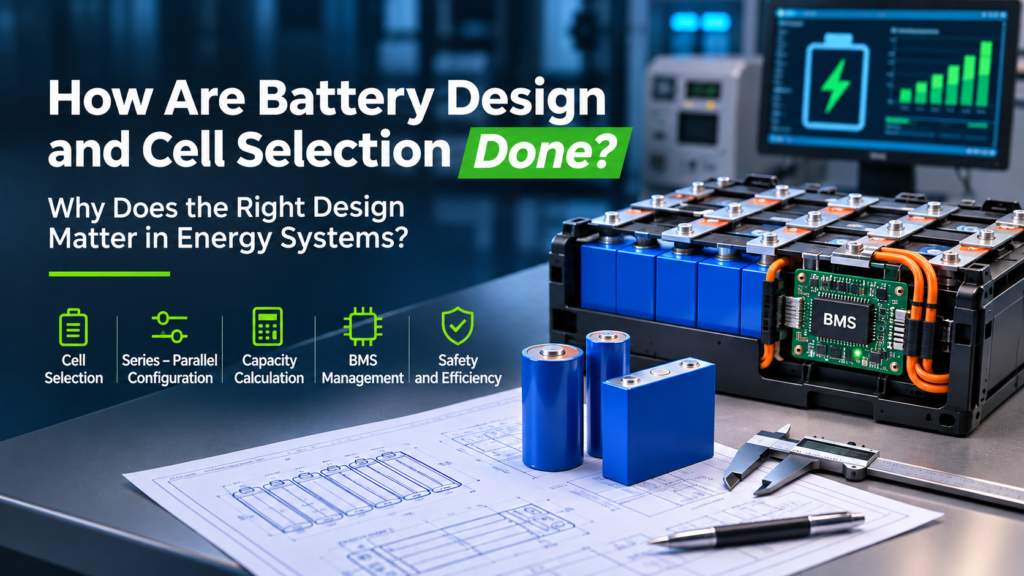
Why Is Proper Design Vital in Energy Systems?
The performance of an energy storage system depends on far more than battery capacity. From electric vehicles and solar energy systems to caravan, UPS and industrial energy storage applications, electrical, mechanical and thermal requirements must be considered together. Battery design is therefore a fundamental engineering process that shapes overall system performance.
Even when high-quality cells are used, poor system design can result in reduced performance, premature capacity loss, charging and discharging imbalances, and safety risks. The widespread adoption of LiFePO₄ technology and growing demand for solar and mobile energy solutions in Türkiye underscore the importance of application-specific cell selection and integrated system design.
What Is Battery Design?
Battery design involves configuring an energy storage system to meet its target voltage, capacity, performance and safety requirements. This process defines the cell technology, connection configuration, battery management system (BMS) and operating conditions.
The primary objective is to achieve an efficient and safe system while minimizing energy losses. Alongside electrical calculations, thermal management and mechanical durability are integral to the design process. In lithium-ion technologies, particularly LiFePO₄ (LFP) systems, even minor design errors can significantly affect service life.
Why Is Cell Selection the Most Critical Stage?
Cell selection is a fundamental design decision that directly influences battery performance and service life. The following criteria should be evaluated when selecting cells for a specific application:
- Capacity
- Internal resistance
- Cycle life
- Safety characteristics
Using unsuitable cells or combining cells with different characteristics in the same battery pack can disrupt operating balance and lead to premature capacity loss. In professional manufacturing processes, cells are individually tested and matched before assembly to mitigate these risks.
What Are the Types of Battery Cells?
Different cell chemistries are used in battery design depending on application requirements. Common technologies include:
- LiFePO₄ (Lithium Iron Phosphate)
- NMC (Nickel Manganese Cobalt)
- LCO (Lithium Cobalt Oxide)
- LTO (Lithium Titanate)
Each cell technology offers distinct advantages. LiFePO₄ cells stand out for their thermal stability and long cycle life, while NMC cells can provide higher energy density. LiFePO₄ technology is widely preferred in energy storage applications where safety and service life are priorities.
Series and Parallel Configurations in Battery Design
Battery pack voltage and capacity are determined by the series and parallel arrangement of its cells:
- Series connection: Increases system voltage.
- Parallel connection: Increases system capacity.
For example, cells in a 12 V-class LiFePO₄ system are connected in series to achieve the target voltage. Parallel cell groups can be used when longer operating times are required. An improperly planned configuration may increase cell imbalances and adversely affect battery service life.
Capacity Calculation in Battery Design
Capacity planning begins with determining the energy requirements of the application. The total energy consumption of connected devices is calculated to select a suitable cell combination. Nominal energy capacity is calculated using the following formula:
Wh = V × Ah
This calculation expresses the nominal energy capacity of the system in watt-hours (Wh). For example, when designing a 12 V, 200 Ah-class battery, the cell count and connection configuration are planned according to the target voltage and capacity.
The BMS (Battery Management System) Is the Heart of Battery Design
The battery management system (BMS) is an electronic control unit that monitors battery operating parameters and manages protective functions when specified limits are exceeded. Its main functions include:
- Monitors cell voltages and, where balancing functionality is available, supports voltage balance between cells.
- Provides protection against overcharging.
- Provides protection against overdischarging.
- Monitors temperatures and manages relevant protective functions.
- Monitors current limits and provides protection against overload.
In LiFePO₄ battery systems, an application-appropriate BMS helps maintain safe operating conditions and supports a long service life.
Thermal Management and Safety Design
Controlling the heat generated by cells during operation is essential to maintaining battery performance. Depending on the thermal requirements of the application, the following components may be incorporated into the design:
- Heat-dissipating surfaces
- Airflow channels
- Thermal sensors
- Active cooling systems
Thermal management is a critical aspect of system design, particularly in applications with high power requirements.
Mechanical Design and Durability
Mechanical design protects cells from external factors and ensures that they are housed in a robust enclosure. Batteries used in caravan, industrial and solar energy applications should be designed with impacts, vibration and temperature fluctuations in mind. Rack-type systems offer advantages through their modular structure and organized installation.
The Impact of LiFePO₄ Technology on Battery Design
LiFePO₄ cells offer significant battery design advantages in terms of thermal stability and long cycle life. However, overall system performance depends not only on cell chemistry but also on engineering design and operating conditions. Voltage behavior may also vary according to cell structure, load conditions and system configuration. These characteristics make LiFePO₄ technology a widely preferred option in modern energy storage systems.